Another Inconvenient Truth
January 4th, 2007by Jude T. Feld
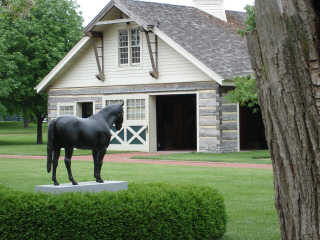
Assorted friends and relatives shipped in to Lexington, Kentucky last week to honor the 50th anniversary of my birth. These visits required me to give several “dime tours” of the Bluegrass. Even though I have lived in Central Kentucky for almost six years, after 44 in L.A., I find myself an “accidental tourist” in my daily travels, still excited at the sight of deer grazing near the airport, cardinals in the trees, foxes in the fields, wild turkeys on the backroads, snow on the evergreens and blazing leaves in the fall.
Many of my peeps on the little tours commented on the new construction, the cleared land and the long lines at traffic signals.
“Yeah, it has turned into another Del Mar,” I said. “Every day more people show up. What was once a five minute drive from 18th Street to the Del Mar barn area is now half an hour from noon on and here, it can take 45 minutes to get from New Circle and Nicholasville Road to the Atomic Café, which was less than a 15 minute trip when I first moved here.”
About two years ago, I suggested to several of my stock-playing buddies that they invest in DuPont, because everywhere I went in Lexington, the word Tyvek appeared, plastered on the new construction dotting the landscape. More and more housing tracts sprouted up along with a plethora of mini-malls while many farms were purchased by developers and traffic got worse and worse.
Even old school Woodford County has allowed housing developments to begin construction which will make Versailles Road even more of a thoroughfare as thousands of new residents find ways on already overcrowded roads to annex the interstates.
In his Academy Award-winning documentary, An Inconvenient Truth, former Vice-President Al Gore presents compelling evidence that global warming is real and it is getting worse. Polar bears are drowning because they have no ice to swim between, the Alps are losing snow exponentially, Icelandic glaciers are melting rapidly and African lakes are drying up daily. This is horrible on a global scale, but we have a similar problem right in our own backyard.
Lexington used to be “The Horse Capital of the World” but now it is the construction capital of our state.
It is appalling that Kentucky is selling its signature industry down the road to builders and developers in search of a quick buck. The wide open spaces are shrinking. The farms are disappearing and when they all go away, what will the Bluegrass have left? A bunch of cookie-cutter houses, some phony modern mansions and a few StarBucks. Eventually, the houses will be worthless and the StarBucks will close because all the great reasons to live in the Bluegrass will have disappeared.
Where will the horses go once the grass that has made them the most valuable animals in the world is covered in concrete patios and asphalt roads? Who will carry the torch for a new generation of Thoroughbred breeders or will Claiborne and Calumet and Darley and Shadwell be all that is left? How will Keeneland survive without a product to sell?
As the Vice president said, “We know what needs to be done. It is time to take action.”

