What’s in a (Stable) Name?
January 19th, 2002by Karen Kubinec
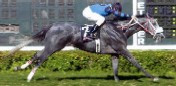
Another M375 Winner
A name gives virtually everything–people, pets, groups and objects–its own identity. Racehorse owners for the most part, are quite picky about what they call their often-expensive equine athletes and their racing stable. Catchy names are part of the tradition of Thoroughbred racing and here at Calder Race Course there are many unique stable names with their own distinct colors. Who knows how they get their names? Here are a few examples:
“Most people put a lot of forethought into coming up with something they like. People enjoy their horses and it’s important to them,” said Rob Murphy, the principle owner of M375 Throughbreds.
M375 is actually a tribute to the former major league baseball pitcher’s favorite horse, the late Seattle Slew. How would you figure that one out? M375, turned upside down, reads like SLEW.
While attending the University of Florida, Murphy majored in computer science. It was during the pre-personal computer days when programs were printed on cards and yards of data were spit out of an IBM printer that took up a whole room. Murphy named his program after his hero that raced at Hialeah, but the monster machine insisted on printing ‘Slew’ upside down. The students tried everything they knew to make the printer type the names right side up and failed. They did, however, think Murphy was a genius when his cards were the only ones to come out with the proper name-hence the program became M375.
Dr. Evangelos Poulos said, “The name is more important to some people than others,” but agrees that it should be tasteful.
Being proud of his Greek heritage, Poulos introduced his White Cross Stable in 1993. The Greek cross, a white cross with four arms of equal length, and the turquoise color of his silks are a representation of the Greek flag.
Falls Racing Stable was named after the country club in Palm Beach that partners Jack Denholtz, Buddy Paulter, Sam Rubin and Elaine Spector are members.
Gail and Timothy Teator named their racing stable Needsmore Thoroughbreds. Though Gail has been involved in the industry most of her life, the Teators have been in the racing end for the past five years.
“In this business you always need more of everything,” she said. “Need more hay, need more room, need more horses…”
That first broodmare they purchased for $1,000 became a stakes producer.
“Now we’re horse poor.”
Lone Stable has been a tradition for over 60 years, first in Puerto Rico and then in the United States. L. Arturo Noble started the Hall of Fame stable in Puerto Rico. He chose that name as he raced by himself until his nephew, Felix Fuertes, entered the racing business.
“My uncle was like a father to me,” Fuertes said. “I took over the stable name after he passed away in 1982 to carry on the tradition of years in the business.”
They raced Calder favorite Liberada, winner of the 1994 Calder Breeders’ Cup, in partnership with Andrade Stable, and stakes winner Papelote, whom they sold prior to the 1977 Kentucky Derby. He raced for the new connections finishing sixth beaten less than 5 1/2 lengths by Seattle Slew.
“That was quite an experience to race a horse of that caliber,” Fuertes said. “Racing is exciting and it gets in your blood. Owners have to have courage to invest in the game these days.”
Fuertes keeps six to eight horses in training at Calder, a few in Puerto Rico and some in the northeast.
Frank and Joanne Bertolino’s Monarch Stable has dominated the top of the owner standings here at Calder and Tropical over the past several years, but it was not new in the racing world. During Bertolino’s 40 years in the business, Monarch Stable had been one of the country’s top-10 owners on nine occasions. Bertolino began racing as San Fran Stable in the 1960s, but changed the stable name to Monarch in 1975 after his horse, Country Monarch.
“I didn’t want people to forget about him. He was one of the best horses in New England at the time,” Bertolino said.
Daniel Frazier is a full-time physician and part-time horse owner, aspiring to become a full-time owner. His family practice is located in Tampa, Florida and his Pyrite Farm is in Ocala. He races horses in Kentucky, Ohio and Florida under the name Pyrite Stable. Many of his horses carry the ‘Pyrite’ in their names. The Fraziers sell a good number of yearlings every year but race quite a few, too, including Graded stakes winner Anet and Regal Joy. His stock has been very dominant at River Downs’ “Best of Ohio” day for many years. They chose the name Pyrite, as in fools’ gold, when Mrs. Frazier expressed her opinion that he “would never make any money.”
Fred Brei retired from his business, a retirement facility in Illinois, in 1995. With his wife Jane, a nurse by profession, he moved to Savannah, Georgia where they planned a quiet life. It wasn’t long before they grew bored and decided to do something exciting, like breeding and racing Thoroughbreds.
Brei, who had previously owned horses, explained the risks and gambles of getting involved in racing. He made her aware of the possibility of spending hundreds of thousands of dollars and coming up with nothing, but also of the chance of developing a champion, all the while relating the horse business to a game Jane knows and understands well-poker. Jane was born and raised on a cattle ranch in northwestern Iowa where one of her family’s favorite pastimes is playing poker.
It was on the drive from Savannah to Ocala to shop for a horse farm that the couple chose the name Jacks or Better Farm.
“We came up with a few different ones and decided on Jacks or Better,” Brei said. “We couldn’t very well call it ‘Craps Stable’,” he said while laughing. With all the nice 2-year-olds they have in the barn this year, it looks like they’re holding their best hand yet.
“When you have a real good horse the stable name becomes real important; the better the horse, the more recognition you get,” said Rick Pitino, whose Ol’ Memorial Stable’s A P Valentine ran second in the 2001 Preakness Stakes.
Ol’ Memorial is named after the golf club in the Tampa area that he, Chris Sullivan (founder of Outback Steakhouse) and a dozen others founded together. Other stables he created were Friendship Stable, Celtic Pride and Running Cardinal; the latter two named after basketball teams for which he has been or is the coach. For Pitino, anonymity played no role in his decision to race under a stable name–it’s because he’s always invested with partners.
“That’s what makes it fun. It wouldn’t be as much fun if I was doing this by myself,” he said.
The criteria for choosing names in the ‘Sport of Kings’ were established by The Jockey Club years ago. The first volume of The American Stud Book was published in 1873 with the registration project taken over by The Jockey Club in 1896. In modern times, New York is the only racing jurisdiction that still requires stable names and racing silks to be registered. An advantage is that once The Jockey Club in Kentucky approves the name and colors, as long as the registration is renewed annually, the owner can keep it forever. It prevents other entities from using famous names, like Claiborne Farm.
As specified by The Jockey Club, a stable name must be unique against other stable names and horse names have an 18-character maximum and cannot contain an owner’s last name other than his own. Trainers are not permitted to run under a stable name. Selected names are not to be connected to any business or used in any way for the advertisement of any product. Also, a description of where the name is derived must accompany the application for approval.
People choose to race under a stable name for a variety of reasons. According to Paul Borroff, Calder’s state licensing official, certain professionals–such as doctors or lawyers–prefer the use of a stable name rather than sporting their own on the public program. However, most often stable names are chosen for corporations (limited partnerships or limited liability companies) which are formed for tax and liability purposes, he said. These corporations keep issues and taxes separate from personal earnings.
“They can choose any name that is morally correct,” Borroff said.

