
Ainslie – Gone But Never Forgotten
September 10th, 2007By Jude T. Feld
For the last 100 years, members of my family have been frequenting racetracks across North America and the Caribbean. I would say that those of us alive as I write this are all if not expert handicappers, more than comfortable reading the past performances. We are “students of the game,†as they say and the time we spend ferreting out winners is considered golden.
Most of my generation’s love for racing and handicapping was inherited from my father, Jack, and also passed down by my uncle, Neil Barton. Their passion for our sport and quest to be better handicappers made them readers of racing literature when that type of material was mostly found on the back shelves of bookstores, much nearer to the girlie magazines than the section that shelved the Dostoyevskys and Balzacs.
Handicapping books of that era were mostly “methods†or anthologies of “systems†with a list of a few rules revolving around days since raced, in-the-money finishes and class changes designed to put the user on “the road to riches.â€
The Speedplay Secret, written by Dick Lillis was a small pamphlet-like book that graced my father’s bookshelf, probably loaned to him by his Aunt Eva – a prolific horseplayer. I used the system laid out by this tome from the age of eight – following the A-B-C-D rules with all the zeal of a Buddhist monk. It provided me with many winners and bought thousands of baseball cards. A clean copy of it recently sold for $56 on eBay – as usual, I was the underbidder.
Making Money on the Races was the book I wrote my first unassigned book report about when I was in the third grade. My teacher, Sister Annette, was non-plussed that a kid my age would be reading such a thing and raked my mother over the coals. Despite the fact that Mom never sassed a nun, she defended me and our family’s love of racing. I still have that old brown book, written by George Sexton, the pertinent parts underlined by my father in blue pencil. An updated version of “The Marathon Method,†one of the “winter season systems†has made me a lot of dough for decades – in spring, summer and fall too.
(Later in the school year, Sister Annette, amazed at my knowledge of fractions, asked me how I knew so much about them. I went up to the chalkboard and drew a racetrack and sketched in the wire and all the eighth and quarter poles. I think she got the point.)
Like the Old Testament, these books had their place in educating the masses. Recent action is important, a close-up finish can be the harbinger of better things to come and it is best to wager on horses who are “running with their friends.â€
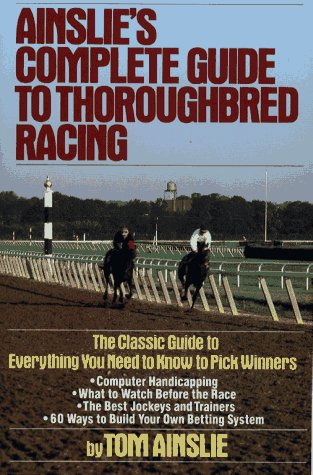
Like Jesus, a new kid came to town. He had a better idea – “The way, the truth and the light,†of Thoroughbred handicapping so to speak. His name was Tom Ainslie and he authored what might be called, “the New Testament of handicapping” – Ainslie’s Complete Guide to Thoroughbred Racing.
Ainslie looked at the big picture. Analyzing every handicapping factor as it related to the others – Distance as it related to class, pace and breeding; final time as it related to pace; workouts and their effect on recent action and what jockeys meant to pace and trainer intention.
He was declared a heretic by the followers of Robert Saunders Dowst when he referred to consistency as “the hobgoblin of little minds,†and looked at skeptically by the disciples of Ray Taulbot when he accepted horses as solid wagers who hadn’t raced in the last 10 days if they had sufficient workouts in the meantime.
This was the Age of Aquarius and these grand ideas were extremely appealing to me. I realized that I had found the Messiah of Mutuels, so, in 1968, at the age of 11, I was ready to sell all my worldly possessions, including my Mays, Koufax and Mantle rookie cards and follow Tom Ainslie to the cashier’s window.
Tom Ainslie got it. Handicapping wasn’t about applying a stringent set of rules to a horse’s past performance chart to deem him worthy of a wager. It was about systematically using a set of concepts when reading the past performances of a race to decide which horses were capable of winning and which ones had little chance of success.
With Ainslie, all horses were under consideration for betting, opening up a new world of possibilities that only Deepak Chopra could appreciate. You didn’t have to throw a horse out that hadn’t raced in a month. You could bet a sharp sprinter to carry his speed a mile and a sixteenth. Maidens and first-time starters were off the “verboten†list and if you loved Dahlia in the Washington D.C. International, you could bet on her against the boys.
Reality. What a concept.
Ainslie opened the door to a whole new set of authors the way Jesus did for the New Testament. Handicappers could now share their methodology with the general public without fear of stoning.
Andy Beyer, whose speed figures are now the rock of Thoroughbred handicapping in the United States; Tom Brohamer, the Prince of Pace; Steve Davidowitz, who knows more about trips than Perillo Tours and Mark Cramer, sort of an odd railbird who invented Kinky Handicapping, could shout their ideas from the mountain tops and be joined by the chorus of a host of others including Dick Mitchell, Jim Quinn, Dan Geer, Len Ragozin and the Gordons Jones and Pine. Handicapping has never been the same and neither have I.
Tom Ainslie was the nom de plume of Richard Carter, a New York native who passed away on September 1, 2007 at the age of 89. His other racing books include The Compleat Horseplayer, Ainslie on Jockeys, The Handicapper’s Handbook – Theory and Practice of Handicapping as well as Ainslie’s Complete Guide to Harness Racing.
The wise words written by Carter as Ainslie continually ring through my brain as I peruse the past performance charts even to this day. They give me the courage to walk to the windows and bet with confidence. I want to thank them both for all the winning days that they have provided me – now and forever. Amen.

