
The Three Wise Men
January 10th, 2004by Jude T. Feld
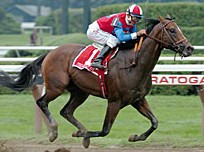
Midas Eyes Takes Forego (G1)
NYRA/Adam Coglianese Photo
One of the nicest things about being a turf scribe is the chance to eat lunch with top class people in turf clubs around the globe. On Saturday, September 4, I had the opportunity to join the “Adoration party” at Arlington Park in Chicago for the $150,000 Arlington Matron.
John Amerman, always a gracious host, was surrounded at the table by several talented handicappers, including my nephew Sean, who is a jockey agent, my brother Bob, who has had a hand in purchasing three Breeders’ Cup winners, trainer David Hofmans, who has never been afraid to visit a mutuel teller and myself.
While knoshing on the great buffet, we began discussing the Forego Handicap at Saratoga. Sean thought Edmund Gann’s Midas Eyes, who is trained by Hall of Famer Bobby Frankel, would bounce to the moon off his impressive comeback victory in an allowance race only ten days before and didn’t want to include him in our group pick four wager. My brother concurred.
Our host, who has several horses in the Frankel barn, said, “I know Bobby. There’s no way he would run this horse unless he thought he was ready for the race.”
“Horses can run back quickly and win,” I added. “In the old days, trainers did it all the time.”
When I was a kid, I read every handicapping book and system I could get my hands on. Most of them discarded any horse that hadn’t a run good race in 14 days or 10 days or some of them even seven! Most claiming horses used to run at least 25 races a year and many stakes horses ran 20 times.
The great Man o’War broke his maiden on June 6, 1919 and won his first stakes race three days later both at Belmont Park. After a “long-layoff” of 12 days, he took the Youthful at the old Jamaica racetrack and was jammed back two days later to win the Hudson at Aqueduct under 130 pounds!
Granted, year-round racing has had an impact on the number of times a horse is sent postward because trainers can be more picky as to where and when to start their charges, but suffice it to say that most racehorses in this century are not overworked.
Seventeen-year-old Sean, has grown up in the age of statistics and information. The Ragozin and Thorograph “sheets” have promoted the “bounce” theory – that a horse coming off a top effort or off a long layoff needs rest between starts in order to duplicate his form. This notion, coupled with the fact that trainers are paranoid about their win percentages and do all in their power to enter only when all the stars align, has caused the average horse to start less than 10 times a year.
When all was said and done, Midas Eyes was left out of our pick four. Mr. Amerman ignored the “experts” banter and plunked a nice wager on Bobby Frankel’s charge. He cashed the only ticket of the afternoon.
Mariensky at Belmont
NYRA/Adam Coglianese Photo
On the grey New York day when the 2003 Belmont Stakes was run, I had the pleasure of watching the magnificent card from California horseman Bahman Abtahi’s turf club table on the Belmont Park finish line. We had a marvelous afternoon, including cocktails and cigars, while visiting the cashier’s line with regularity.
There was a couple at an adjacent table, who were not enjoying the same luck at the windows that Mr. Abtahi and I were having. The gentleman told me he was “getting destroyed” and asked if I had a horse that “could get him out for the day.”
“I love Mariensky in the Just A Game Breeders’ Cup,” I replied. “I think she’s a cinch.”
“Huh!” his wife exclaimed. “That filly has no chance. She’s running back in a week.”
“That’s why I like her,” I said. “She ran great in the Sheepshead Bay over a soft turf and Christophe Clement wouldn’t run her back that quick unless she was at the top of her game. We already know she’ll like the soggy ground.”
Ignoring his wife’s guffaws, the fellow backed my selection and was cheering loudest of all when she crossed the wire in front.
The main focus of this piece is not a handicapping lesson, although it never hurts to upgrade the chances of a horse with the benefit of a recent race. From a Thoroughbred owner’s standpoint, there are some more import points to consider.
Owners love action. Everybody enjoys visiting the barn and petting their horses in the stall, watching them munch hay, get their bath after morning work and feeding them carrots, but more than anything else, owners want to watch their horses run. Trainers know this, and often feel the need to temper the owner’s enthusiasm for racing.
It is o.k. to run a horse back quickly once in a while but several back-to-back starts will often sap a horse for the rest of the year. An owner should feel free to discuss his horse’s schedule with the trainer, but circling every possible spot in the condition book is a bad idea.
The reverse is also true. If your trainer suggests running a horse back quickly, give him or her the benefit of the doubt. Unless you are a “hands-on” owner, it is impossible for you to know from your office in Philadelphia how your horse in New Orleans is feeling. Ultimately, trainers want to win races and the best ones know when their horse is sitting on a victory.
Bobby Frankel said of Midas Eyes after the Forego, “He was sound and feeling good, so we had to take a shot.”
Mr. Gann got the trophy and Mr. Amerman cashed his bet – obviously three very wise men.

